SWFT, cATO, 20x and the Rev. 4 Drag Still Inside DoW Cloud Authorization
DoW and FedRAMP are both pushing authorization toward greater speed, reuse, and continuous validation, whether through SWFT, cATO maturity, or FedRAMP 20x’s evidence-first model. At the same time, many downstream consumers still operate with Rev. 4-era package assumptions, tooling, and review habits. That gap creates a practical problem: a package assessed against Rev. 5 can be fully sound and still be difficult to inherit from.
At a glance
- Direction of travel: faster authorizations, greater reciprocity and reuse, and more continuous monitoring and validation
- Where friction shows up: package consumption lags package modernization, especially around inheritance mapping, artifact navigation, and POA&M and evidence traceability
- What “Rev. 4 drag” looks like: extra clarification cycles, manual crosswalking, and inconsistent reviewer interpretation
What helps: maintain a Rev. 5 source of truth and provide a downstream-friendly translation layer
Why this is surfacing now
The modernization trend itself is not surprising. DoW is emphasizing faster software delivery and faster authorization pathways, including SWFT, while cATO maturity and continuous monitoring are becoming more central to how programs operate at speed. In parallel, FedRAMP 20x is signaling an end state in which evidence is more machine-readable, validation is more continuous, and narrative-heavy packages carry less of the burden.
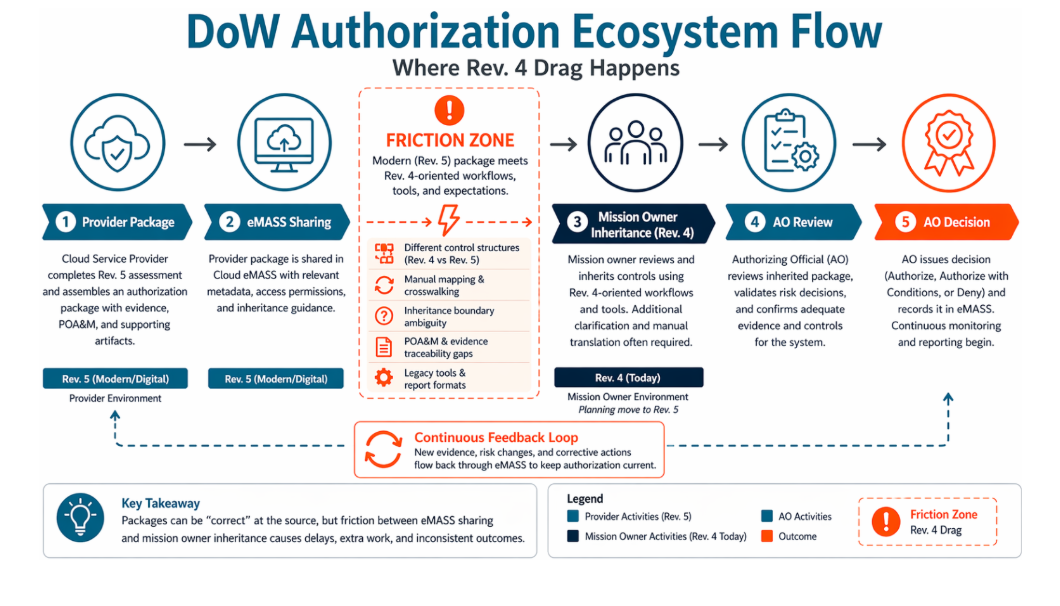
The friction emerges later, when a provider has already modernized to Rev. 5 and is preparing for that future state, while mission owners and local review workflows still expect Rev. 4-shaped package structures. In a reciprocity-driven ecosystem, passing the assessment is only part of the job. The package also has to remain usable by downstream consumers.
Why it matters beyond compliance
Mixed-revision drag shows up in operations quickly. It creates schedule pressure, increases support demand, and can make a completed assessment less reusable than it should be.
- Slower mission onboarding: more back-and-forth is needed to interpret package changes
- Reduced inheritance value in practice: consumers hesitate to inherit when responsibility boundaries are unclear
- Greater interpretation variance: different reviewers reconstruct the package differently
Higher hidden cost: providers spend more time producing crosswalks, briefings, and one-off evidence pulls
Where the Rev. 4 drag comes from in DoW
1) Inheritance continuity
Downstream teams do not just need confirmation that a provider passed an assessment. They need to inherit controls safely and move quickly.
- Reorganized control statements can make it harder to see what remains inherited and what shifted to the mission owner
- When a consumer workflow is still shaped around Rev. 4, reviewers often fall back on manual mapping and additional clarification cycles
2) Artifact translation and reviewer usability
A package can become harder to review even when the underlying security posture has improved, particularly when it is optimized for technical correctness without enough attention to downstream consumption.
- Reviewers need a straightforward way to distinguish substantive security changes from packaging and document changes
- Crosswalk views and concise “what changed and why” summaries reduce cognitive load and help decisions move faster
3) POA&M and evidence continuity
Traceability is part of package usability. When findings and evidence no longer map cleanly across revisions, the review process turns into record reconstruction.
- Stable finding identifiers and mapping tables are valuable when controls or statements are reorganized
- Inherited obligations and residual risk should be understandable without requiring a live walkthrough every time
4) Timing and ecosystem mismatch
Providers are being asked to build for the future state while still supporting today’s consumers.
- FedRAMP 20x-style evidence models and cATO expectations will continue raising the bar for automation-ready outputs
Many mission teams will not modernize their workflows and tooling on the same timeline, which makes transition support part of delivery rather than a side task
A practical playbook: one program, two interfaces
Providers do not need to run two separate compliance programs. What they need is one Rev. 5 source of truth, supported by a stable translation layer aligned to how downstream consumers still review and inherit today.
- Maintain a Rev. 5 source of truth. Treat Rev. 5 controls and evidence pipelines as authoritative rather than forking the SSP program. Prepare for 20x modernization.
- Publish or re-use Rev. 4-to-Rev. 5 crosswalk. Cover controls, responsibilities, and artifacts in a format that is consistent and repeatable. Ensure Mission Owner requirements are accounted for.
- Provide an inheritance-first summary. In one page, show what is inherited, what is shared responsibility, what is mission-owned, and what changed since the last package version.
- Preserve POA&M lineage. Stable IDs and finding-to-control-to-evidence mapping tables are high-value transition tools.
- Include a reviewer-ready brief. Separate posture changes from packaging and structure changes so reviewers are not forced to infer the difference.
Automate incrementally. Start with recurring evidence such as scans and configuration state, then move those outputs toward real time machine-readable formats that support continuous (vs point in time) validation.
Closing thought
The direction is clear: faster software delivery, continuous authorization, and evidence that is increasingly machine-readable. During the transition, one of the clearest differentiators is whether a package remains easy to inherit from and easy to review in DoW. The teams that handle this well are not waiting for every downstream workflow to catch up. They are building the translation layer now while continuing to mature the underlying evidence pipeline toward automation. If your team is navigating mixed-revision package friction, our teams can help. Contact InfusionPoints today to talk through transition planning, inheritance continuity, and evidence portability.