The Email FedRAMP CSPs Cannot Ignore: The December VDR/VER Emergency Test
By Tanner Bailey · Associate, InfusionPoints · 9 min read
For FedRAMP Cloud Service Providers, one of the most consequential compliance messages of the year is expected to arrive in just over a month.
During the November 4th FedRAMP Community Working Group event, FedRAMP outlined how it plans to assess CSP readiness for the mandatory transition to Vulnerability Detection and Response (VDR) and Vulnerability Evaluation and Reporting (VER).
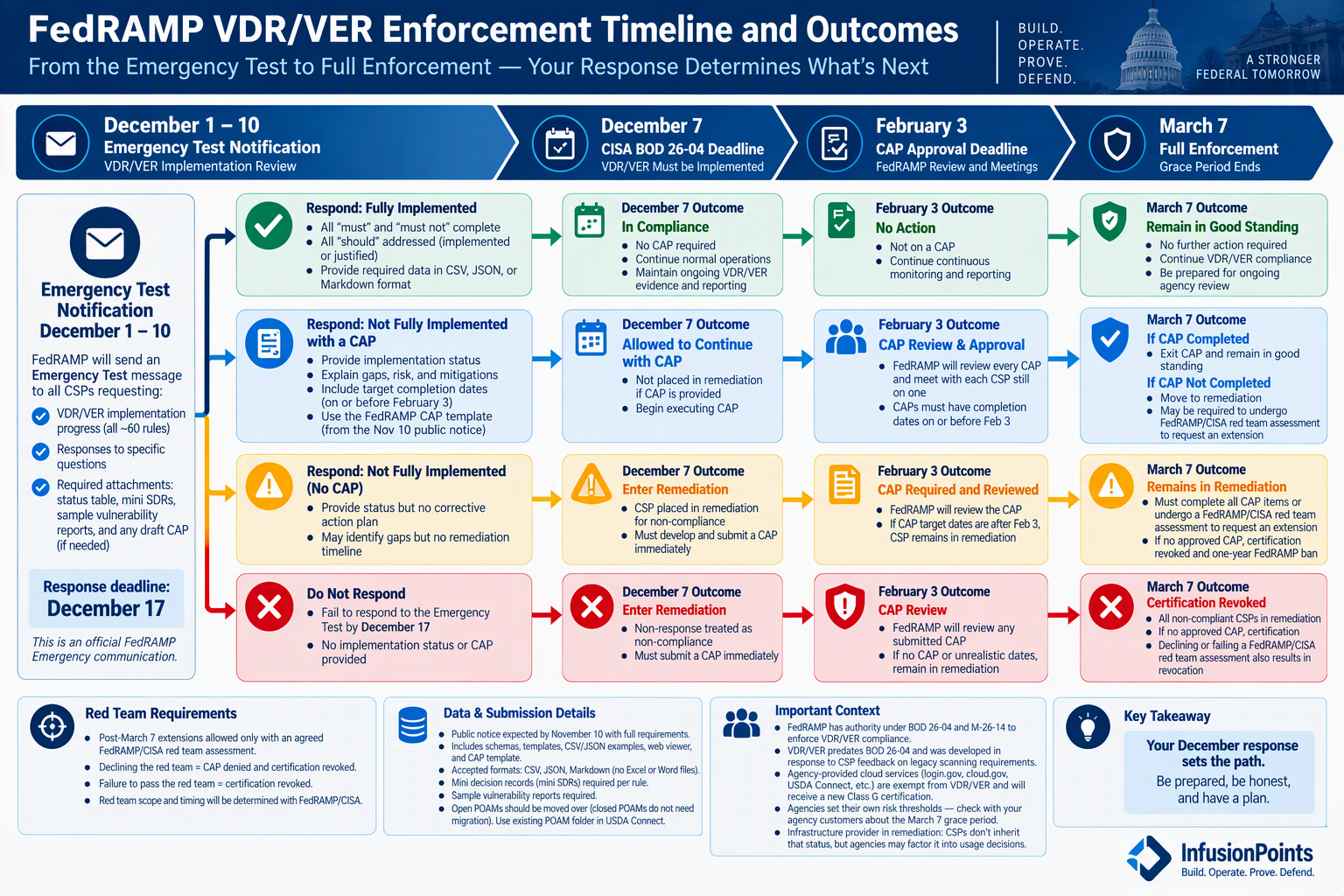
Between December 1 and December 10, CSPs should expect an Emergency Test notification asking them to demonstrate where they stand with VDR/VER implementation.
This will not be a simple “confirm receipt” exercise.
CSPs will need to respond with their VDR/VER implementation progress, answer implementation questions, and identify any requirements that remain incomplete. The responses will then determine which of three categories CSPs fall into:
- CSPs that have fully implemented VDR/VER
- CSPs that need to be placed on a Corrective Action Plan
- CSPs that may enter FedRAMP remediation processes with risks toward FedRAMP Certification Revocation
The stakes are real.
FedRAMP's published Consolidated Rules already establish December 7, 2026, as the date VDR and VER become mandatory for obtaining a new FedRAMP Certification or maintaining an existing FedRAMP certification. They also establish March 7, 2027, as the end of the transition grace period.
The December Emergency Test is FedRAMP's mechanism for determining where each CSP stands.
This Emergency Test Is Different
FedRAMP CSPs should already understand the importance of an Emergency-designated message.
In July 2026, FedRAMP sent an Emergency Test message requiring providers to route Emergency-designated communications to a senior security official and respond by a specific deadline.
Following the July test, FedRAMP also demonstrated that these tests have enforcement consequences. 652 cloud service offerings, approximately 99%, responded to the test, while non-responsive offerings were placed into remediation pending certification revocation.
The December exercise raises the stakes further because CSPs are expected to demonstrate not merely that their communication channel works, but that they have actually implemented VDR/VER or have a credible plan for completing the transition.
FedRAMP has already made its position clear: legacy monthly vulnerability scanning alone is insufficient to satisfy the new vulnerability-management expectations.
So when the December message arrives, “we received the email” will not be enough.
The real question will be:
Have you implemented VDR/VER per Consolidated Rules 2026? If not, why, and what are you going to do to fill the gap?
What CSPs Should Expect to Provide
Based on the Community Working Group discussion, CSPs should prepare for a rule-by-rule accounting of VDR/VER implementation.
For each applicable requirement, CSPs should be ready to identify the requirement as:
- Fully implemented
- Partially implemented
- Not implemented
- Not applicable
But the status alone is not enough.
Each rule should have a short explanation describing how the requirement has been implemented or why implementation remains incomplete, like a mini Security Decision Record.
For incomplete requirements, CSPs should be prepared to identify:
- The remaining implementation gap
- The risk created by that gap
- Current mitigations
- The target completion date
- Enough information for FedRAMP to understand the CSP's path to compliance
“Fully implemented” is also expected to mean more than satisfying requirements using the word must. Based on the Working Group discussion, CSPs should be prepared to account for the should requirements as well, either demonstrating implementation or documenting a reasonable basis for not implementing a recommendation.
What Happens After the CSP Responds?
The easiest way to understand the December process is as a decision tree.
Scenario 1: VDR/VER Is Fully Implemented
This is the target state.
The CSP responds to the Emergency Test with the requested implementation information and demonstrates that applicable VDR/VER requirements have been addressed.
Expected result: No VDR/VER gaps → No CAP required → Continue ongoing FedRAMP compliance.
The important qualification is that declaring implementation is not the end of the obligation.
VDR requires providers to continuously identify, analyze, prioritize, mitigate, and remediate vulnerabilities through an ongoing operational process.
VER likewise requires providers to determine when vulnerabilities are likely to affect federal customers and report those vulnerabilities appropriately.
In other words, this is not an implementation project that ends in December. It becomes part of the CSP's continuous security operating model.
Scenario 2: VDR/VER Is Not Fully Implemented, but the CSP Has a Credible CAP
This is the scenario the grace period is designed to address.
A CSP determines that it cannot honestly mark every applicable VDR/VER requirement as fully implemented.
Rather than trying to hide those gaps, the CSP identifies them and provides a concrete corrective-action path.
Based on the Working Group discussion, that means the CAP should make it easy to determine:
- What is missing
- Why it matters
- How risk is being mitigated
- Who owns the fix
- When it will be completed
Expected result: Incomplete VDR/VER → Credible CAP → FedRAMP review = Continued certification without a remediation listing on the FedRAMP Marketplace during the approved transition.
This approach aligns with FedRAMP's published rules, which explicitly allow FedRAMP to require additional vulnerability information, alternative reports, or different reporting frequencies as part of a Corrective Action Plan.
The key is that the CAP must represent an actionable remediation plan, not simply a list of requirements the CSP has not completed.
Scenario 3: VDR/VER Is Incomplete and There Is No CAP
This is where the risk increases dramatically.
CSPs will have until December 17 to respond to the Emergency Test. Providers that are not fully implemented and do not have an appropriate corrective-action path will be moved into remediation.
The practical decision tree becomes:
Incomplete VDR/VER + No Acceptable CAP = In Remediation Marketplace designation.
CSPs should not wait for the December Emergency Test to determine whether a CAP is necessary.
If a rule-by-rule assessment performed today shows that the CSP will not be completely implemented in December, the CAP-development process should begin before the notification arrives.
February 3 Becomes the Next Critical Milestone
The Working Group discussion also identified February 3, 2027, as the next major CAP milestone. Any CAPs a CSP develops should target full implementation of all VDR/VER requirements by no later than February 3, 2027. Don't miss this.
CSPs cannot wait until the March 7 grace period to finish implementation.
March 7 Is the Enforcement Backstop
FedRAMP's VDR and VER rules identify March 7 as the end of the grace period.
FedRAMP has also publicly stated that providers may maintain certification during the grace period while operating under a corrective action plan.
The implementation target remains December 7.
The period between those dates exists to accommodate CSPs with legitimate implementation gaps and credible corrective-action plans, not to provide an additional three months before providers begin implementing VDR/VER.
Your December Response Sets the Path
The December Emergency Test represents more than another FedRAMP reporting exercise. It is the point at which CSPs will need to demonstrate whether VDR/VER is operational, identify where implementation gaps remain, and show that those gaps have a credible path to resolution.
The distinction between remaining in good standing, operating under a CAP, entering remediation, and ultimately putting a FedRAMP certification at risk could come down to how prepared a CSP is to answer one question:
Have you implemented VDR/VER, and if not, can you demonstrate a credible, timely, and transparent plan to get there?
The Emergency Test may not arrive until December, but the time to prepare the response is now.

Your December response sets the path.
Know where implementation stands, document what remains, and prepare a credible plan before FedRAMP asks.